
The say-do gap is the distance between what consumers tell you they will do and what they actually do when price, habit, availability, and context enter the decision. For CPG insights teams, that gap shows up everywhere: concept tests with strong purchase intent, sustainability claims people endorse but do not buy, and launches that pass research but stall on the shelf. The instinct is to treat it as an error to scrub out of the data, the more useful move is to read it as a finding. The gap can tell you whether demand is real, whether friction is too high, or whether the research asked the wrong question.
A few years ago I was reviewing a concept test for a new product. The numbers were beautiful. Something like 78% of respondents said they'd "definitely" or "probably" buy. The team was thrilled. I remember a stakeholder saying the quiet part out loud: "if even half of them actually buy, we're golden."
They did not buy it. Not half, not a quarter. And when the launch underperformed, the post-mortem reached for the usual suspects — pricing, distribution, "the market wasn't ready." Nobody pointed at the obvious culprit sitting in the research deck the whole time: the gap between what people said and what they did.
The gap is not new, and it's not small
The first time anyone systematically caught humans saying one thing and doing the opposite, it wasn't in a brand tracker. It was 1934.
A Stanford sociologist named Richard LaPiere spent two years driving across the United States with a young Chinese couple, at a time of intense anti-Chinese prejudice. They visited 251 hotels, restaurants, and auto camps. They were refused service exactly once. Months later, LaPiere mailed those same establishments a questionnaire asking whether they would serve Chinese guests. Of the ones that replied, roughly 90% said no.
Think about what that means. The same businesses that had just served this couple warmly, in person, overwhelmingly declared on paper that they'd turn them away. What people said and what they did weren't slightly misaligned. They were opposites.
This is one of the oldest problems in research; economists have known since Samuelson in 1938, they call it the intention-behavior gap (Sheeran).
This isn't a one-study curiosity. It's one of the most robustly quantified findings in behavioral science:
- The landmark meta-analysis of experiments that changed people's intentions found that a medium-to-large shift in intention produced only a small-to-medium shift in behavior (d = 0.36). In plainer terms: you can move what people say a lot, and barely move what they do. (Webb & Sheeran, 2006)
- Across the broader literature, intentions explain roughly 30% of the variance in actual behavior. The other ~70% lives somewhere your survey question never went. (Sheeran & Webb, 2016)
- Roughly half of people who form a genuine health-related intention (to exercise, to attend a screening) fail to act on it. (Sheeran & Webb, 2016)
And in our world specifically — purchase intent:
- Two of the most common ways teams turn stated intent into a forecast (mean intent, or % top-box) routinely produce biased estimates, overstating or understating real purchasing. (Morwitz, Steckel & Gupta, 2007)
- Some estimates put the conversion of stated purchase intentions into actual purchases as low as ~10%. (Morwitz et al., 2007)
- And there's a measurement trap that should keep every insights lead up at night: when you measure intention and behavior on the same respondents, the act of asking inflates the apparent link between the two. Studies that do this overstate how predictive intent really is — which may be exactly why a new product's success rate looks like 80% in a same-sample test and closer to 50% when the launch is bet on intent thresholds alone. (Chandon, Morwitz & Reinartz, 2004)
In CPG, this comes right down to the launch. Only about 15% of new products are still on shelf and viable two years after release (Nielsen), and plenty of them passed concept testing before they shipped. Stated purchase intent is unreliable enough on its own (GreenBook). When a correction factor has to carry that much weight, the stated number is no longer the insight. The gap is.
Why the gap exists — and why "people are liars" is the wrong answer
The lazy interpretation of the say-do gap is that respondents lie. They don't, mostly. The gap is structural, and it comes from at least four distinct sources. Figuring out which source is driving your particular gap is the whole point.
1. The question is cheap; the behavior is expensive. Saying "yes, I'd buy this oat milk" costs a respondent nothing: no money, no fridge space, no breaking of an existing habit. The real decision happens at a shelf, with a price, against the brand they already trust, while three kids are pulling at the cart. Intention is measured in a frictionless world. Behavior happens in a world made entirely of friction.
2. Social desirability. People answer as the person they'd like to be. They overstate intent to buy healthy, sustainable, premium, or socially-approved things, and understate the guilty, cheap, or embarrassing ones. This is exactly the bias LaPiere caught, and it's strongest precisely where brands love to play: wellness, sustainability, "better-for-you."
3. Habit and autopilot. A huge share of consumption is automatic. Your stated intention to "try something new" walks into the store and loses, instantly, to the cue-routine-reward loop that's been running for years. Intentions rely on deliberate willpower; behavior often doesn't involve the deliberate system at all.
4. The forecast is contaminated by the asking. Measuring intent can change behavior, and same-sample designs inflate predictive validity. Sometimes the gap is real consumer psychology; sometimes it's an artifact your own method manufactured. (Chandon, Morwitz & Reinartz, 2004)
The size and shape of the say-do gap is itself a measurement. A gap driven by social desirability tells you something completely different about your brand than a gap driven by habit lock-in, and both are different from a gap that's just an artifact of how you asked the question. Most teams collapse all of this into a single apology ("well, you know, stated intent always overshoots") and throw away the most diagnostic thing in the study.
Why can't behavioural data explain the say-do gap?
Oftentimes the response is to stop asking and start watching what people are actually buying: purchase data, in-market tests. Behavioral data is essential; it is honest about what happened, but it cannot explain the say-do gap by itself.. It records that someone bought the cheaper option and never tells you they almost didn't, or what would have moved them to a competitor. It also arrives too late: you rarely get real-time behavioral data on a concept that does not exist yet.
That leaves a hole.
Surveys capture the stated answer but often miss the reasoning behind it. Behavioral data captures the action but not the motivation. The gap lives in between, and neither method can reach it alone. To make it useful, teams need to diagnose what kind of gap they are seeing.
Not all gaps are the same
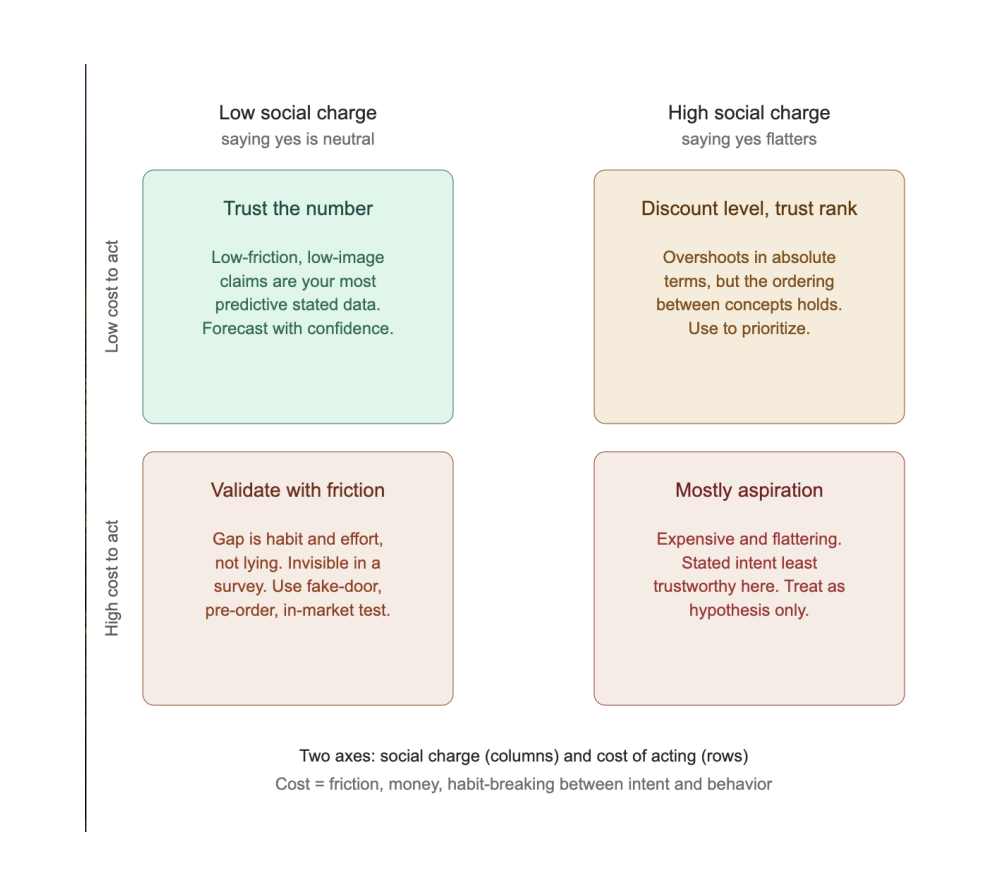
A practical way to diagnose the gap is to plot the claim on two axes: cost of acting and social charge. Cost of acting is the amount of friction, money, effort, risk, or habit-breaking required to turn an intention into behavior. Social charge is the extent to which saying “yes” makes the respondent look virtuous, smart, healthy, sustainable, premium, or aspirational.
The goal isn't to close the gap. It's to know which gap you're looking at, because that's what tells you whether a research result should change the launch, the claim, or nothing at all.
Each source of the gap points to a different signal. A large gap on a high-friction, socially loaded claim, a premium sustainable product, say is almost certainly aspirational rather than predictive. A gap on a low-friction, neutral claim is more likely telling you something real about the product or the price. Collapsing them into the same correction factor means losing the most specific information in the study.
The goal isn't to close the gap. It's to know which gap you're looking at, because that's what tells you whether a research result should change the launch, the claim, or nothing at all.
How do you measure the say-do gap on scale?
To understand the gap you need both halves at once: what someone says, and what they actually end up doing.
A real conversation can produce both.
Ask a person to talk and they give you the stated answer, then, they become more conversational, revealing the workaround they have used for years, or the last time they switched brands and what set the change off. The divergence stops being a mystery and becomes legible once you take the opportunity to speak to the consumer looking at your product.
The reason teams settled for surveys is that quality conversation is incredibly difficult to produce at scale. One moderator could run a handful of interviews a week, so depth meant a sample size of just a few. That trade-off doesn't have to exist. Keplar runs AI-moderated voice interviews with hundreds of real customers at once and codes them automatically. You get the qualitative context at the sample size you would normally reserve for a quant study.
How do you measure the say-do gap on scale?
To understand the gap you need both halves at once: what someone says, and what they actually end up doing.
A real conversation can produce both.
Ask a person to talk and they give you the stated answer, then, unprompted, the workaround they have used for years, or the last time they switched brands and what set the change off. The divergence stops being a mystery and becomes legible once you take the opportunity to speak to the consumer looking at your product.
The reason teams settled for surveys is that quality conversation is incredibly difficult to produce at scale. One moderator could run a handful of interviews a week, so depth meant a sample size of just a few. That trade-off doesn't have to exist. Keplar runs AI-moderated voice interviews with hundreds of real customers at once and codes them automatically. You get the qualitative context at the sample size you would normally reserve for a quant study.
What does understanding the say-do gap get you?
Once you can see why the gap opens, it stops being a risk and starts becoming an insight. A claim that tests well and sells poorly signals an unresolved barrier between intention and action. A concept that wins on a survey and stalls on the shelf reveals a disconnect that prediction alone cannot explain. The value isn't in measuring the gap more precisely; it's in understanding what created it. That understanding comes from hearing consumers explain their trade-offs, hesitations, and workarounds in their own words. That's what conversational research at scale is built to uncover.
Your data isn't lying to you. It's telling you, very precisely, where words and behavior part ways. The only question is whether your research is deep enough to listen.
FAQ
What is the say-do gap in CPG research? The say-do gap is the difference between what consumers say they will do in research and what they actually do in the market. In CPG, it often shows up when stated purchase intent is high but real trial or repeat is low.
Why do surveys have a say-do gap? Surveys capture a stated answer with little of the surrounding context, and they ask people to predict their own future behavior, which they often do poorly. Social desirability and after-the-fact rationalization widen it further.
How should insights teams use the say-do gap? Insights teams should treat the gap as a diagnostic signal. The size and source of the gap can reveal whether the problem is price, habit, social desirability, product fit, message credibility, or research design.
Can you eliminate the say-do gap? You cannot eliminate it, and trying to is the wrong idea. People are predictably hard to decode, so some gap will always exist. The win is understanding why the gap opens for a given concept, which is what tells you how to change the product, the claim, or the message.
See for yourself how Keplar is able to help you understand the gap here, or book a meeting with us here to find out more