
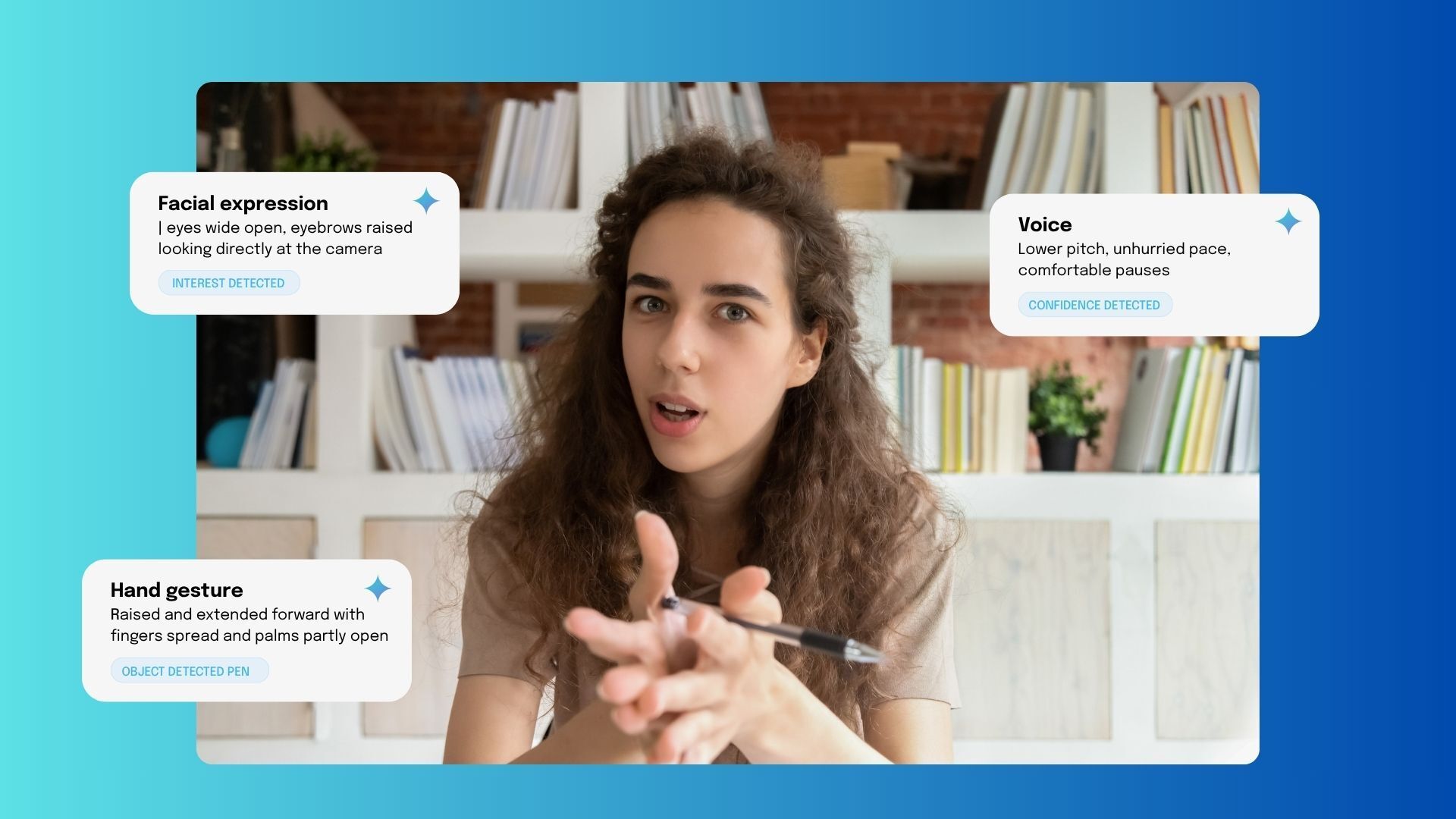
Video intelligence in AI-moderated research is having a hard time delivering on its promise. Without a human on the other end, participants default to flat, transactional responses, making sentiment data largely noise. Video earns its cost in observational research (shop-alongs, product tests, habit tracking), not interview sentiment.
When I was 26 and felt like I was "getting old… FAST" and needed anti-aging treatments ASAP, I frequented a beauty salon where I'd always try to buy the most expensive products on the shelf. My cosmetologist—who was technically supposed to be selling these products—would always stop me: "Oh, Polina, don't do that. It's just marketing."
After spending this week exploring the concept of "video intelligence" in AI-moderated research, I can't help but think the exact same thing: It's just marketing.
Don’t get me wrong—we offer video interview capabilities in Keplar, and there are absolutely good use cases for the medium. But the way it’s currently hyped in the research industry feels like a sales claim detached from actual methodological value.
In this post, I’ll share the results of my experiments so you can draw your own conclusions—or better yet, share your POV (because I'd love to be proven wrong).
The Dream of ‘Video Intelligence’
As a researcher, the ultimate goal is always to capture every possible human signal. That’s why the prospect of having video recordings of AI-moderated interviews—complete with the ability to analyze sentiment based on tone, facial expression, and body language—sounds like a dream.
Imagine the possibilities:
- A richer signal for every study.
- Nuanced sentiment analysis that catches what a text transcript misses.
- Object and brand detection automated within the video frames.
- Compelling highlight reels to bring the voice of the customer alive for executive stakeholders.
- All of this at a fraction of the traditional cost and time.
The Reality
In reality, there are critical flaws that, in my opinion, mean video recordings of AI-moderated interviews simply aren't worth the investment.
Video Quality
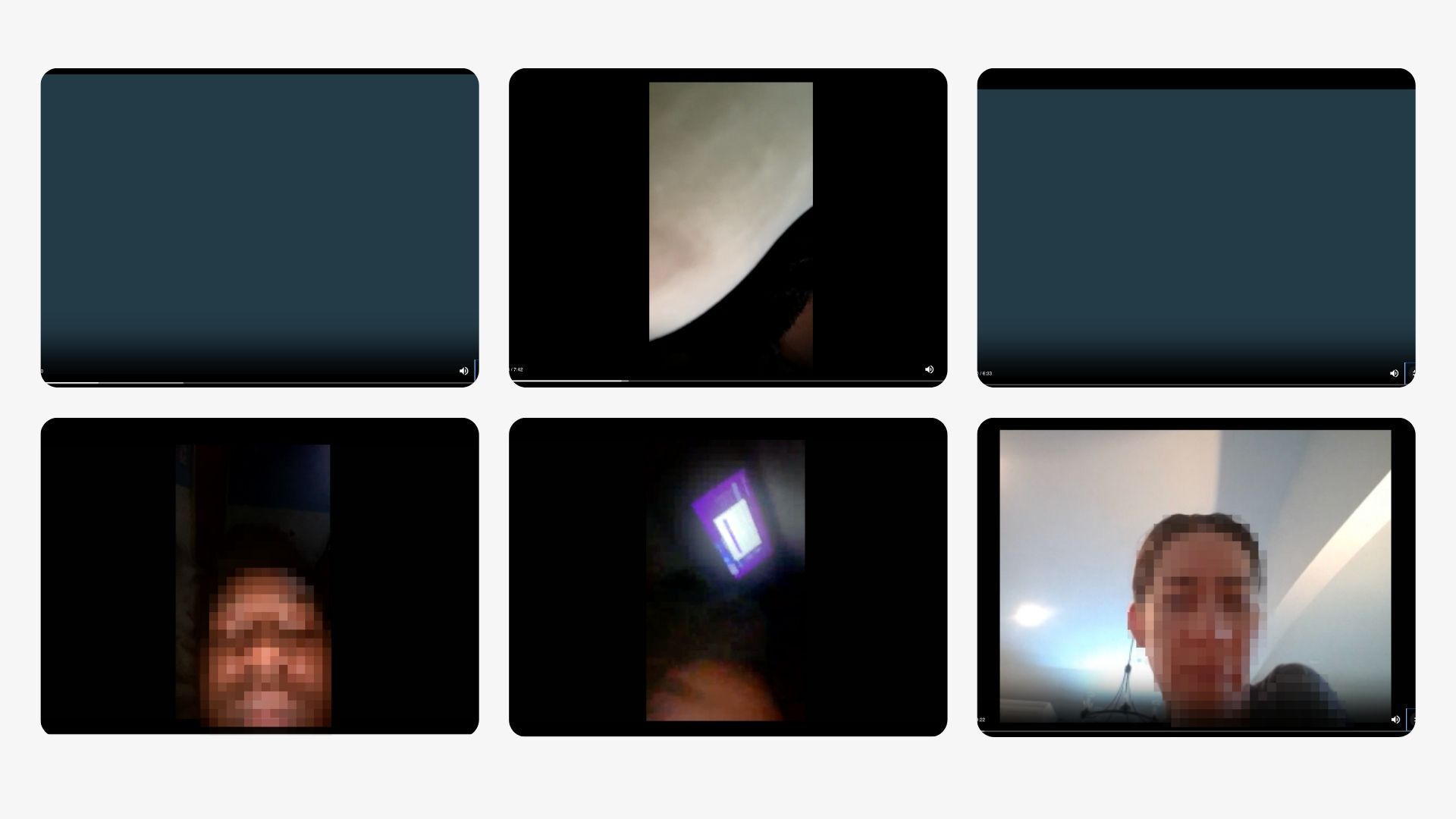
This is a snapshot of the first six video interviews in my study. It doesn’t exactly look like the dream or “executive highlights reel material”, does it?
But it makes sense. Participants in quantitative panels are accustomed to completing surveys for $3 to $4 each, often doing them right before bed or while watching TV. Suddenly, a participant in her pajamas clicks on a link that demands her camera turn on. What does she do? She covers the lens, points it at the ceiling, or does her best while lying on a couch in a pitch-black room.
To get executive-ready video quality, you need higher compensation and a specialized recruitment approach—which drives the cost and effort right back up to traditional, human-led interviews.
The Insights Quality
Now let’s look at the data and signals we are actually retrieving. The marketing promise is that you can capture immensely valuable non-verbal signals at scale, vastly outperforming text transcripts. However, we have to remember a fundamental truth: human non-verbal communication is a response, not a monologue.
Communication researchers Burgoon, Buller, and Woodall spent decades establishing that humans deploy non-verbal cues—microexpressions, postural shifts, leaning in—in direct response to the non-verbal signals of the person they are interacting with. Widened eyes, an involuntary grimace, or leaning forward in engagement are all triggered by human presence, social stakes, and reciprocal exchange. They are conversational by nature; they aren't just emitted into a void.
When a participant is "interviewed" by a voice AI, there is nothing on the other end to react to. No facial expressions, no human warmth, no socially loaded pauses. Lacking those triggers, participants default to a "Transactional Mode"—the same flat affect you use when navigating an automated phone menu. It's functional, minimal, and emotionally empty.
In Just Enough Research, Erika Hall emphasizes that qualitative research lives and dies on the quality of the interaction. Skilled moderators lean into discomfort; they notice when a participant's words and body language contradict each other, and they probe that gap. That dynamic is exactly what drives authentic expression—and it's exactly what a voice AI cannot replicate.
As a result, our non-verbal data lacks a valid baseline. The participant isn't reacting to your research stimulus; they are reacting to the bizarre experience of talking to a machine. Those are not the same thing.
What about AI avatars? Before suggesting avatars as a fix, consider that they introduce an entirely different problem. Today's avatars are realistic enough to trigger a social response, but not realistic enough to sustain it. Participants end up reacting to the artificiality of the avatar itself. The uncanny valley doesn't just make people uncomfortable; it actively contaminates your data.
Furthermore, emotion inference from video data is incredibly unreliable. Long story short: the technology just isn't there yet. So, we end up analyzing a synthetic non-verbal interaction using unreliable ML tools.
The Risk of Bias
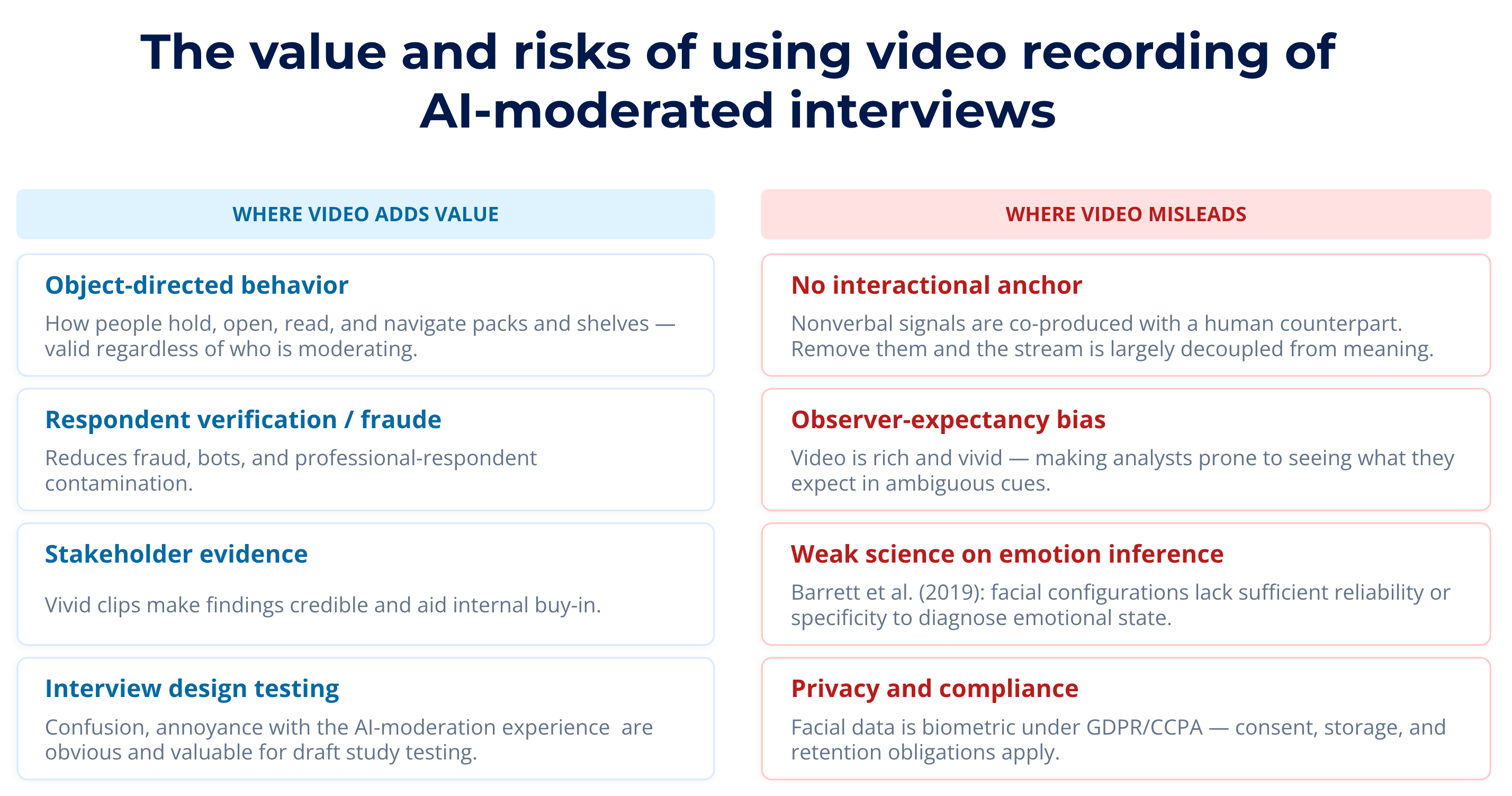
To top it off, dipping in to watch just 2 or 3 videos out of a 500-person study introduces massive implicit biases:
- "Their house is a mess; they must be an unreliable source of information" (Horn Effect).
- "This person doesn’t look like a buyer of our premium hand soap, so their insight doesn’t feel valid" (Affinity Bias).
From a strict methodological standpoint, sentiment data inferred from AI-moderated video interviews is largely just noise.
Where Video is Actually Worth the Investment
Recording participants is incredibly valuable when the goal is understanding object-directed behavior—in other words, observational research:
- Virtual & Mobile Shop-Alongs: Consumers film their shopping journey (in-store or on an app). The AI tracks decision paths and immediately probes on impulse triggers—like why they swapped a name-brand item for a generic one at checkout.
- In-Use Product Tests: Participants use a new beauty or household product on camera. The AI dynamically reacts to real-time feedback, asking targeted follow-ups like, "You mentioned the texture felt 'different'—what did you mean by that?"
- Multi-Day Habit Tracking: The AI handles automated daily check-ins (e.g., tracking breakfast choices for a week) via quick video prompts, mapping out behavioral shifts and routines over time without human researcher fatigue.
- Video Pantry Audits: Instead of relying on flawed consumer memory, users scan their cupboards on video. The AI logs true product inventory, uncovering competitor brands and adjacent categories they actually keep stocked.
- The "First Open" Unboxing Test: Participants film themselves opening a new package design. The AI actively looks for signs of physical struggle (like reaching for scissors or using teeth) and asks, "It looked like that safety seal took some effort—tell me what happened."
- Executive Alignment and Consumer Empathy: small-sample dedicated recruit with higher cost, specifically for executive highlight reels and sharables…the whole study doesn’t need video.
- Meal Prep Audits: Users film their real cooking process. The AI observes natural behavioral quirks—such as a consumer ignoring microwave instructions entirely—and pauses to ask, "Is this how you normally prepare this meal?"
- On-the-Go Consumption Diaries: To catch raw impulse behavior, hundreds of consumers record a 30-second clip the exact moment they open a snack or beverage. The AI automatically categorizes the environment (e.g., in the car, at the desk) and logs their immediate emotional state.
Conclusion
The underlying thesis isn't wrong. There are genuine research applications where non-verbal data is critical and irreplaceable. Byron Sharp and the Ehrenberg-Bass Institute have long argued that behavioral observation—watching what people actually do versus what they say they do—is where the richest insights live.
Shop-alongs, ethnographic home visits, and in-context observational research are all environments where non-verbal cues are natural reactions to a real-world stimulus (a product, a retail shelf, a physical space) rather than an AI voice prompt. That is where video intelligence starts making real sense.
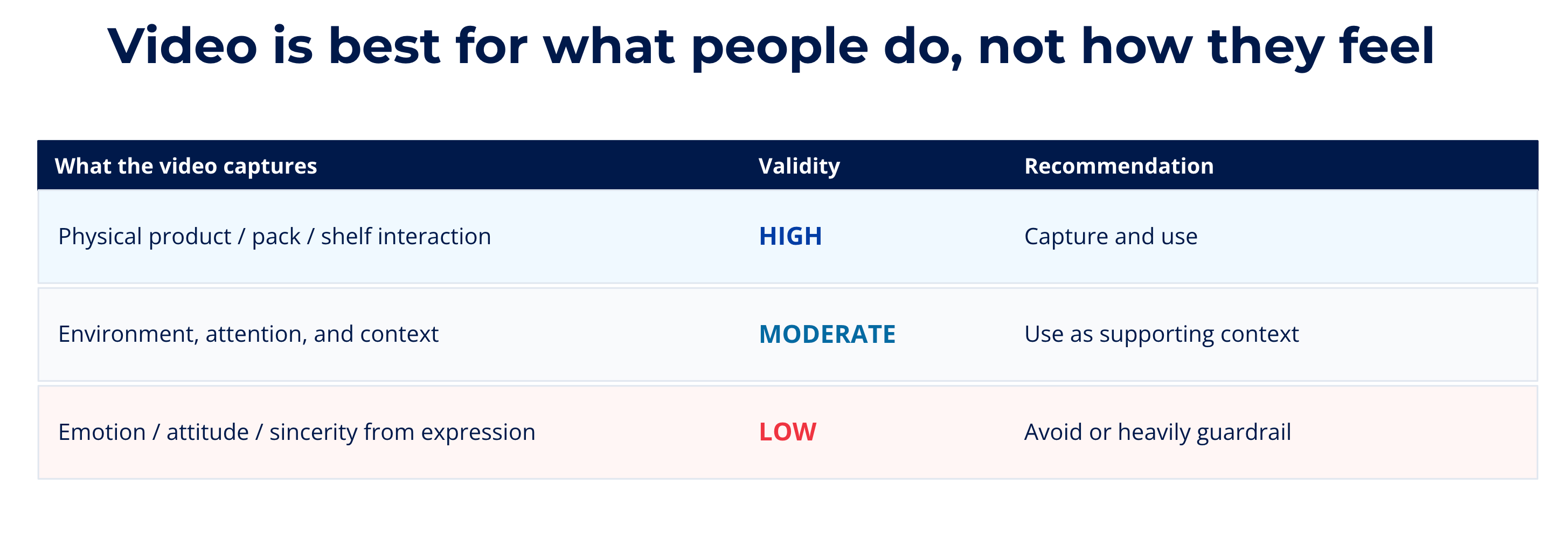
If in doubt, here’s an easy framework to follow:
I’d love to get your thoughts. What's the take from other leaders in the research and insights community?
FAQ
What is video intelligence in market intelligence? AI analysis of video recordings to extract sentiment, emotion, and non-verbal cues at scale. Whether it works depends on whether participants are reacting to a real stimulus, or just talking to a machine.
Does AI-moderated video research work for sentiment analysis? Not reliably. Without a human on the other end, participants default to a flat, transactional effect. Emotion inference tools aren't accurate enough for research-grade conclusions. Treat it as noise, not signal.
When is video worth using in AI-moderated research? When the goal is observational, not conversational, shop-alongs, product tests, pantry audits, consumption diaries. When participants are just answering questions into a camera, video adds little.
Are AI avatars a solution to the interactional problem? Not yet. They're realistic enough to trigger a social response but not realistic enough to sustain one. Participants react to the artificiality of the avatar, not your research questions.
What are the risks of reviewing video clips from a large-scale study? Sampling bias. Watching 2 or 3 clips out of 500 introduces the Horn Effect and Affinity Bias, neither of which show up in your aggregate data, but both of which quietly shape executive conclusions.
If you're curious what this looks like in practice, you can try Keplar here or book a chat with us.